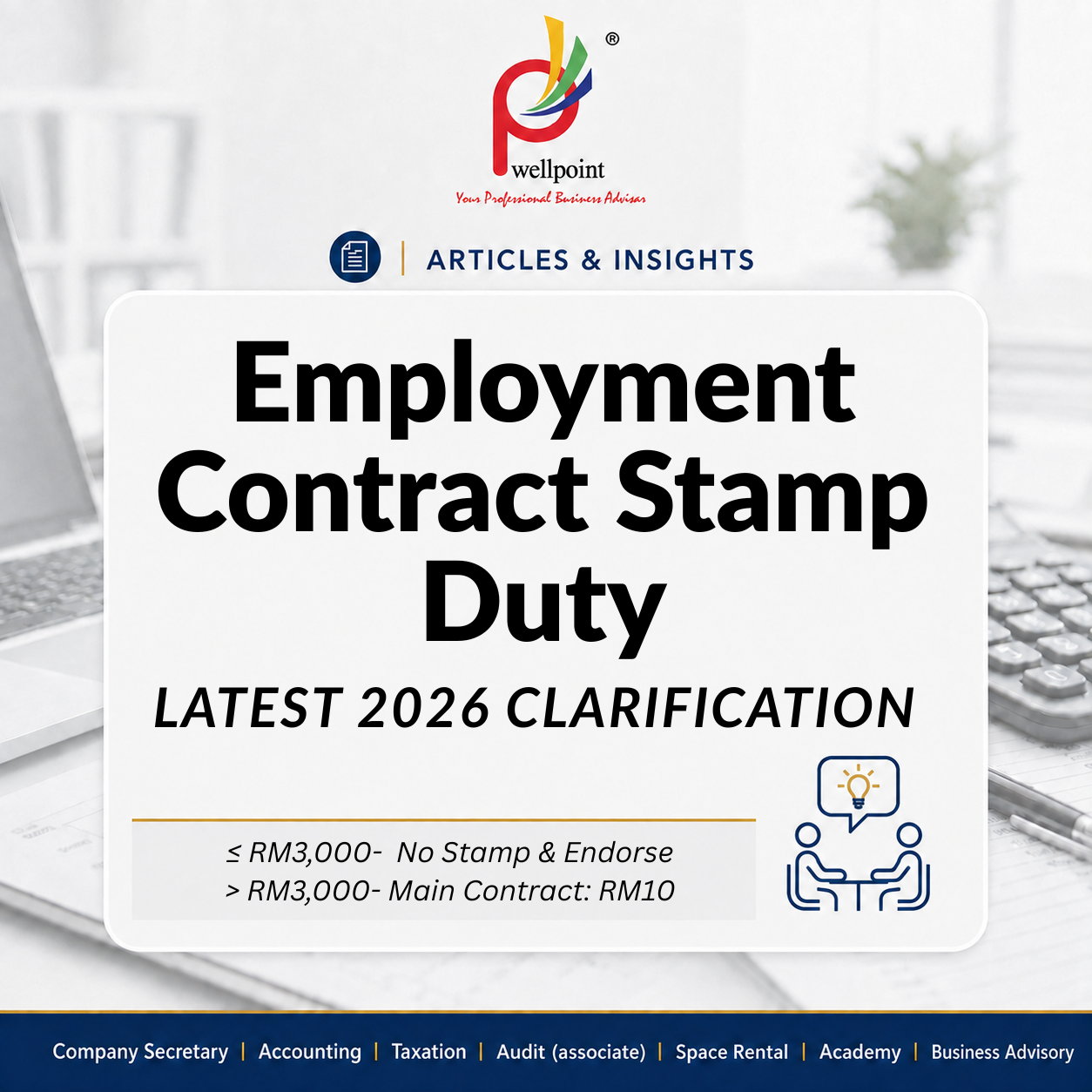
Employers in Malaysia may still be uncertain about whether every employment-related document needs to be stamped and endorsed.
On 7 August 2026, the Inland Revenue Board of Malaysia (HASiL) issued an important clarification on the stamp duty treatment of employment contracts and related instruments.
The treatment depends mainly on the employee’s monthly remuneration, the date the employment contract was executed, and the nature and contents of the document.
What You Need to Know
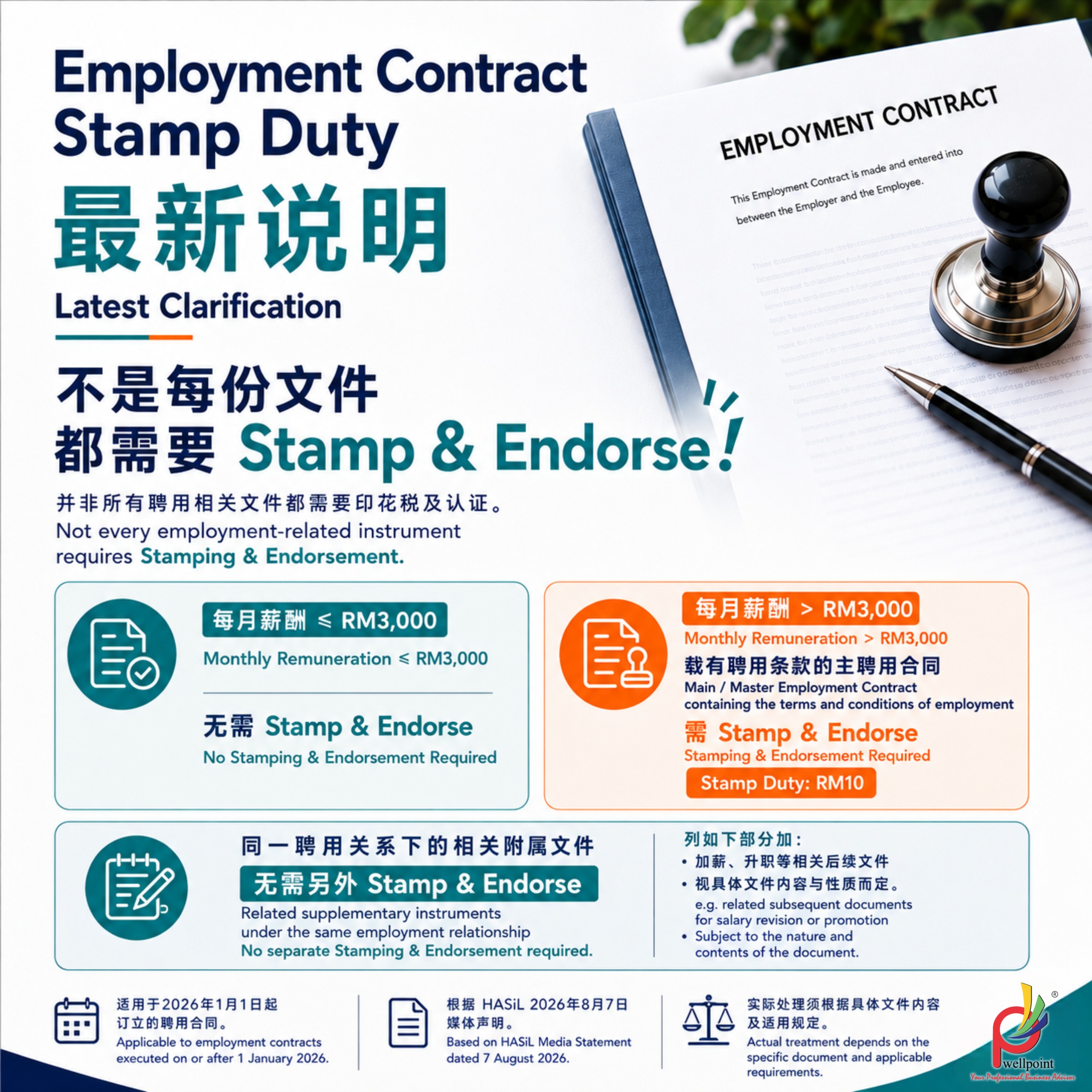
1. Monthly Remuneration Not Exceeding RM3,000
SSM has announced a waiver period from:
1 July 2026 to 31 August 2026
For employment contracts falling within the exemption category where the employee’s monthly remuneration does not exceed RM3,000, HASiL has clarified that the instrument:
- does not need to be stamped; and
- does not need to be endorsed.
The increased RM3,000 threshold applies to employment contracts executed from 1 January 2026.
This is an important clarification for employers because an exempt employment contract within this category does not need to be submitted merely to obtain an exemption endorsement.
2. Monthly Remuneration Exceeding RM3,000
Where the employee’s monthly remuneration exceeds RM3,000, the employment contract does not fall within this exemption.
HASiL has clarified that only the main or master employment contract containing the terms and conditions of employment between the employer and employee needs to be stamped and endorsed.
For an employment contract that falls under the applicable agreement provision of the Stamp Act 1949, the stamp duty is generally:
RM10
Employers should therefore identify which document actually establishes the main terms and conditions of the employment relationship.
3. What About Supplementary Employment Documents?
Employers often issue additional documents after an employee joins the company, such as documents relating to revisions, benefits or other employment matters.
Under HASiL’s latest clarification, related supplementary instruments under the same employment relationship do not require separate stamping and endorsement.
However, employers should not rely solely on the title of a document.
The actual nature, contents and legal effect of the document should be considered to determine whether it is genuinely a supplementary instrument relating to the same employment relationship or constitutes a separate instrument requiring different treatment.
Who Does the RM3,000 Exemption Apply To?
The RM3,000 exemption threshold applies to qualifying employment contracts executed from:
1 January 2026
For these contracts:
Monthly remuneration ≤ RM3,000
→ No stamping and endorsement required.
Monthly remuneration > RM3,000
→ The main or master employment contract containing the employment terms and conditions is generally required to be stamped and endorsed.
Employers dealing with contracts executed before 1 January 2026 should review the rules applicable to the relevant period separately, as earlier contracts may be subject to different exemption, remission or compliance arrangements.
Take Note of the Stamping Deadline
Where an instrument is required to be stamped, timing remains important.
Generally:
- an instrument executed in Malaysia should be stamped within 30 days from the date of execution; and
- an instrument executed outside Malaysia should generally be stamped within 30 days after it is first received in Malaysia.
Late stamping may result in penalties under the Stamp Act 1949.
Employers should therefore review documents that require stamping promptly instead of waiting until a compliance review or audit identifies an outstanding instrument.
What Should Employers Do?
Employers should review their employment documentation by considering the following:
- Check the date the employment contract was executed.
- Determine the employee’s monthly remuneration for purposes of the applicable exemption.
- Identify the main or master employment contract containing the employment terms and conditions.
- Review whether other documents are genuinely supplementary instruments under the same employment relationship.
- Arrange for timely stamping where the main employment contract is subject to stamp duty.
- Seek clarification where the nature or legal effect of a document is uncertain.
A document should not be submitted for stamping merely because it is employment-related. At the same time, employers should not assume that every document described as a “supplementary letter” is automatically outside the stamping requirements.
The correct treatment depends on the specific document and the applicable provisions of the Stamp Act 1949.
Key Takeaway
The latest clarification can be summarised simply:
Not every employment-related instrument requires Stamping & Endorsement.
For employment contracts executed from 1 January 2026, the RM3,000 monthly remuneration threshold is an important starting point.
Where monthly remuneration does not exceed RM3,000, qualifying employment contracts are exempt and do not require stamping and endorsement.
Where monthly remuneration exceeds RM3,000, employers should identify and stamp the relevant main or master employment contract, while related supplementary instruments under the same employment relationship generally do not require separate stamping and endorsement.
Official Reference
This article is based on the latest clarification issued by the Inland Revenue Board of Malaysia (HASiL) on 7 August 2026.
HASiL Media Statement: Stamp Duty Treatment for Employment Instruments
View the official HASiL media statement
Need Assistance?
If you require further clarification or professional assistance, feel free to contact Wellpoint Corporate Group.
For further enquiries, please contact:

Customer Success | Jocelyn
012-693 5428